

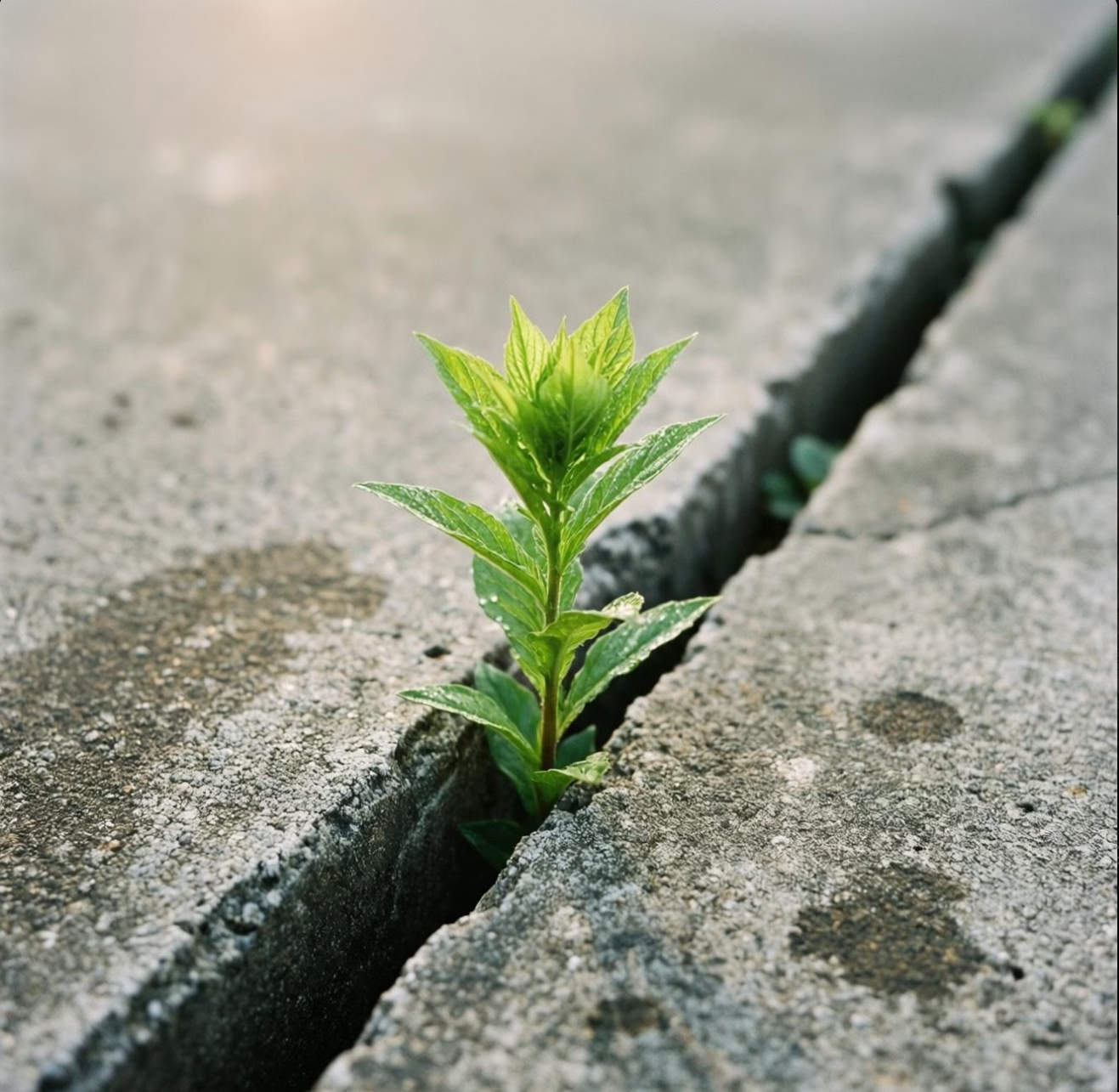
Word of the Day: Resilience. जानिए यह शब्द सिर्फ़ मज़बूती नहीं, बल्कि टूटने, झुकने और फिर से संभलकर आगे बढ़ने की गहरी मानवीय क्षमता को कैसे बयान करता है।
Word of the Day: Resilience
There is a word in the English language that does not arrive with a shout, but with a slow, steady breath—a word that belongs not to those who never fall, but to those who fall, wince, and decide to stand anyway. That word is resilience.
Resilience does not glitter. It does not promise that life will be smooth, or that you will be spared from failure, grief, or disappointment. Instead, it quietly offers something far more realistic and far more powerful: the capacity to absorb impact, to bend without breaking, and to rebuild what has been shaken. Where gumption is the starter motor that gets you moving, resilience is the suspension system that keeps you going when the road turns rough.
Origins and Sound
The word resilience finds its roots in the Latin verb “resilire,” meaning “to spring back” or “to recoil.” Over time, it travelled through Middle French and into English, first used to describe physical objects—materials that could take a hit and regain their shape. A resilient metal bar. A resilient fabric. Something that yields for a moment, then remembers what it is.
Say it out loud: reh‑ZIL‑yuhns. It starts softly, with that almost apologetic “re‑”, then tightens around the “zil”—sharp but small—and loosens again into “yuhns,” as if exhaling. The sound itself feels like contraction and release, tension and letting go. It is not a hard punch of a word. It is more like the sound of someone getting back up and brushing the dust from their knees.
Meaning
At its core, resilience is the ability to recover from difficulty—not by pretending the difficulty never existed, but by moving through it without losing yourself. It is the capacity to be affected and yet not be defined solely by what happened.
Resilience is not invincibility. The resilient person still cries, doubts, and has days when they think, “I cannot do this.” What sets them apart is not a lack of pain, but a certain stubborn willingness to keep turning towards life instead of away from it. It is the human version of a tree that bends in the storm. It does not resist the wind with brittle defiance; it yields just enough to survive, then straightens when the sky clears.
Synonyms, Antonyms, and Texture
Resilience sits in a crowded family of words, but it has its own distinct texture. Its closest companions include toughness, endurance, fortitude, grit, and stamina. Yet each of these misses something. Toughness often suggests hardness, an inability or refusal to be moved. Endurance hints at lasting, but not necessarily adapting. Grit focuses on willpower, on teeth‑clenched persistence.
Resilience, by contrast, is not only about lasting; it is about adapting. It makes room for flexibility, for learning, for subtle shifts in how you see yourself and the world. It allows softness in the middle of strength. A resilient person is not made of stone; they are more like woven fibres—capable of stretching, absorbing, and still holding together.
Its antonyms draw an even sharper outline. Fragility, collapse, despair, defeatism, burnout, brittleness: these are states where pressure leads to permanent damage or withdrawal. Where resilience says “I am shaken, but still here,” fragility whispers “I have shattered,” and defeatism mutters “Why try at all?”
One might say resilience is the bridge between vulnerability and strength: it accepts the first and grows into the second.
Usage in the Wild
You rarely see resilience standing on a stage with a spotlight. More often, it shows up in small, unreported moments.
Resilience is the student who fails an important exam, spends a night in tears, and then quietly emails the professor to ask, “What can I do better? Can I try again?”
It is the shopkeeper who has to shut down a beloved family business in one neighbourhood and, after months of doubt and paperwork, opens a smaller stall in another part of town.
It is the person who goes through a breakup that cracks something deep inside them—and still, piece by painful piece, rebuilds a life that has laughter in it again.
Resilience appears in rehabilitation centres and in living rooms, in hospital corridors where relatives sit with tired eyes, in classrooms where shy children stand up to read again after stumbling the week before. It lives in the way a community comes together after a flood or a fire, sweeping the streets, sharing meals, and saying to one another, “We will make this livable again, somehow.”
Resilience and Time
One of the most misunderstood aspects of resilience is timing. The modern world, impatient and restless, often demands quick rebounds: “Move on.” “Get over it.” “Be strong.” But true resilience is not speed. It is not measured by how fast you stop crying, but by how honestly you move through what you feel and still eventually choose life.
Grief can last months or years. Trauma may leave echoes that flare up without warning. Resilience does not erase these; it simply means that, over time, your capacity to carry them grows. The weight does not always shrink, but your shoulders widen.
So resilience is not the glossy social media post where everything seems fine again. It is the quiet decision to keep showing up, even when the story does not yet have a happy ending.
Resilience in the Body and Mind
Although we often speak of resilience in poetic terms, it also has a very real, physical side. The nervous system, for instance, learns from repeated stress and recovery. People who gradually build healthy coping mechanisms—sleep, movement, honest conversations, boundaries—often find that future challenges feel less annihilating. Their bodies have rehearsed the act of coming back.
Psychologists talk about “psychological resilience” as the ability to adapt well in the face of adversity, trauma, threats, or significant sources of stress. It does not promise the absence of anxiety or low moods; it suggests that, even during those states, a person finds reasons and methods to continue engaging with life rather than retreating completely.
In this sense, resilience is less like armour and more like a well‑used toolkit: familiar, reliable, sometimes rusty, but there when you need it.
Resilience vs. Denial
It is important not to confuse resilience with denial. Denial says, “Nothing is wrong.” Resilience says, “Something is very wrong, and still I will try to respond.”
Denial suppresses pain and often prolongs it; resilience acknowledges pain and works around and through it. A resilient person does not insist they are okay when they are not. Instead, they may say, “I am not okay right now—but I trust that ‘right now’ is not forever, and I am willing to do the work that bridges this moment to a different one.”
Examples in Everyday Life
You see resilience in:
– The caregiver who has spent years tending to a chronically ill parent, whose days are marked by repetition and exhaustion, and yet who still finds small pockets of humour and tenderness in the routine.
– The migrant worker who moves to a new city with limited language skills, faces rejection after rejection, but continues to search, learn, and gradually carve out a space in an unfamiliar landscape.
– The athlete who suffers an injury just before a major tournament, undergoes surgery and months of physiotherapy, and then chooses to train again—not with the same body as before, but with a new respect for its limits and strengths.
– The young person who grows up hearing, “People like you don’t reach those positions,” and yet applies for the scholarship anyway, walks into rooms where they feel out of place, and slowly realises they have every right to sit at the table.
Resilience as a Choice and a Skill
Unlike height or eye colour, resilience is not purely genetic. While some temperaments may lean more easily towards optimism, resilience is, to a large extent, a set of habits and attitudes that can be developed.
It begins with a simple but powerful shift: from “Why is this happening to me?” to “Given that this is happening, what can I still do?” That small change in question moves a person from helplessness to a sliver of agency.
Over time, resilience grows when you:
– Allow yourself to feel what you feel, without labelling your emotions as “weak.”
– Reach out for help instead of assuming you must carry everything alone.
– Treat small improvements as victories worth noticing, not as disappointments because they are not dramatic enough.
– Tell yourself stories that include both your struggles and your efforts, not only your failures.
In other words, resilience is not about pretending the wall is not there; it is about slowly learning how to climb it, walk around it, or, in some cases, accept that it stands and build a different path.
Resilience in a Complex World
In a world that often feels like a barrage of crises—from personal to global—resilience becomes more than a private virtue; it is a shared survival skill. Economies fluctuate, technologies outpace our ability to emotionally adjust, and news cycles make yesterday’s shock feel old by lunch.
In such a landscape, resilience is not a luxury. It is the quiet infrastructure beneath our days. It allows teachers to show up for another classroom full of restless students after a week of exhaustion. It allows healthcare workers to return for another shift after witnessing loss. It allows friends to answer one another’s late‑night messages with, “I am here. Let’s talk.”
Unlike privilege, resilience is not something you are simply born with or without. It grows in the spaces where people support one another, validate each other’s pain, and still encourage one another’s potential.
The Character of Resilience
If resilience were a person, it would not be the loud motivational speaker on stage, urging you to “crush” your goals. It would be the friend who sits beside you on the kitchen floor after a disaster, helps you list the next three smallest steps, and shows up again the next day to ask how step one went.
It would not mock your tears. It would hand you a glass of water. It would not insist that everything happens for a reason; it would accept that some events are simply cruel, and still ask, “What do you need to move forward at all?”
Resilience respects your breaking points. It does not shame you for reaching them. It quietly invites you to discover that perhaps your breaking point was not the end of the story, only the end of a chapter.
How to Nurture Resilience
Resilience grows best in certain conditions. It is nourished when you:
– Build routines that anchor you—sleep, meals, movement, small rituals that remind your body it is safe enough to rest.
– Seek out people who can hold both your struggles and your strengths in the same conversation.
– Practise reframing: instead of “I failed,” try “I tried, I learned something specific, and I am deciding what to adjust.”
– Allow yourself to be a beginner again and again, even in adulthood.
Ironically, resilience often grows strongest in the very seasons when you feel weakest. You do not notice its full presence while you are in the middle of surviving. It shows itself later, when you realise, looking back, “Somehow, I made it through that. I am not who I was before—but I am still here, and in some ways, more fully myself.”
Resilience and Hope
Resilience and hope are not the same, but they are close companions. Hope looks ahead and says, “A better outcome is possible.” Resilience bridges the gap between this belief and the hard steps required to move towards it.
Without hope, resilience can turn into mere grim survival. Without resilience, hope can dissolve into fantasy. Together, they create a kind of grounded courage: a willingness to imagine better days, paired with the stubbornness to endure this one.
In a life where certainty is a rare luxury, resilience offers something different: not a guarantee, but a promise to yourself that you will keep participating in your own story, even when the plot twists without warning.
To have resilience is not to be unbreakable. It is to be repairable—and to trust that, with time, care, and support, you can become not the same as before, but still whole.
In the end, resilience is not a single heroic act. It is the accumulation of small choices: to try again, to ask for help, to rest instead of quitting, to believe that your future self deserves the chance you can give them today.
In a world that can bruise and bewilder, resilience is the quiet, stubborn decision to keep showing up.













Leave a comment